
 Enlarge Cover
Media/Desk Copy Request
Enlarge Cover
Media/Desk Copy Request
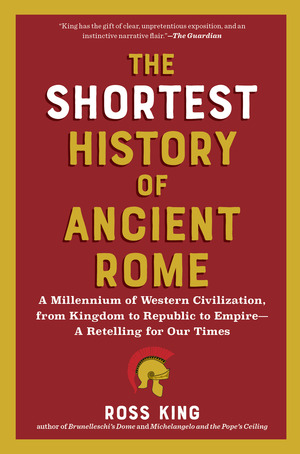
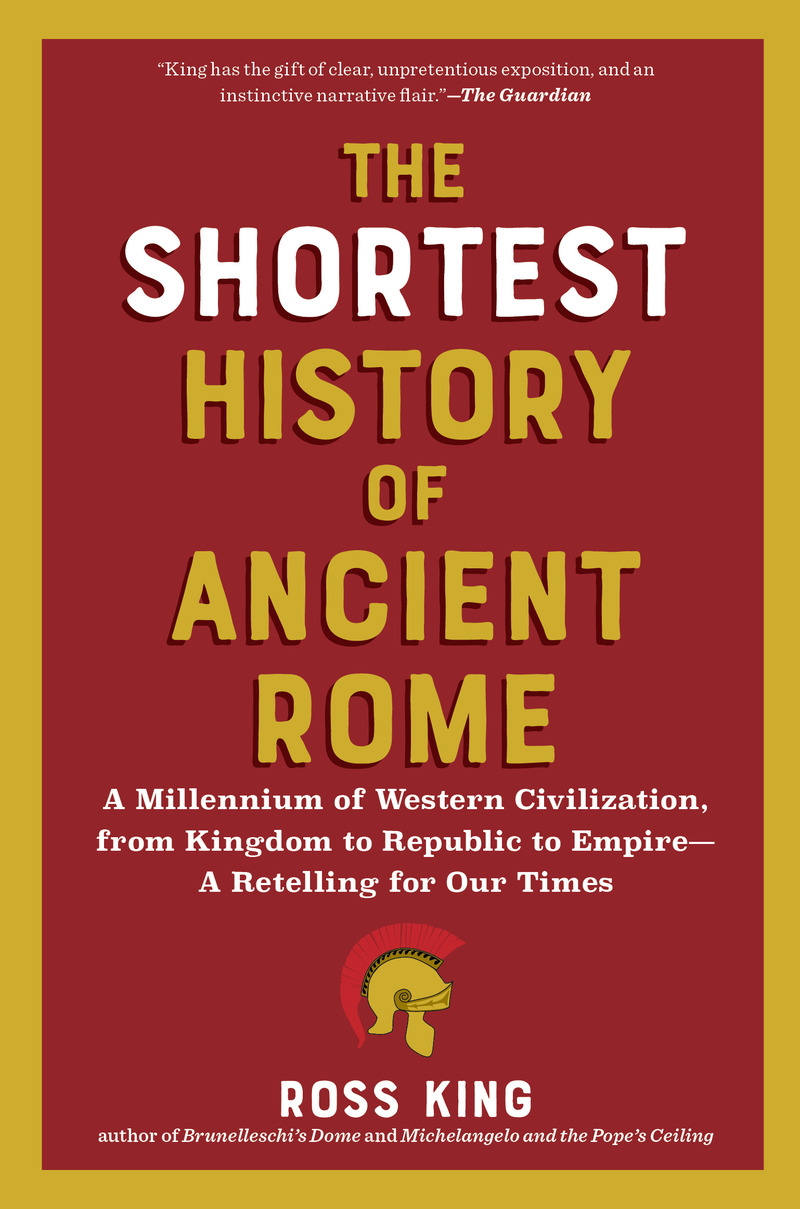
From New York Times–bestselling author Ross King, the storied rise and reign of the greatest empire and most influential civilization of the ancient Western world “For who is so indifferent or indolent as not to wish to know by what means the Romans succeeded in subjecting nearly the whole inhabited world to their sole government—a thing unique in history?”—Polybius, second century BCE
Ancient Rome gave rise to the Roman Empire, one of history’s greatest civilizations. It flourished for roughly five hundred years and, at its height, made up at least 20 percent of the world’s population. It left an indelible mark on the world, shaping politics, laws, philosophy, and architecture, and gave us Roman numerals, the calendar, aqueducts, and concrete. Alongside the Greeks, the Romans laid the groundwork for Western civilization.
In this fast-paced history, Ross King introduces the emperors and warriors, the madmen and upstarts, and the artists and gladiators responsible for the empire’s rise, reign, and ruin. King’s vivid narrative offers fresh context for key political and religious events and paints lively portraits of Rome’s most formidable and notorious leaders. Spanning over one thousand years of Roman history, The Shortest History of Ancient Rome brings an ancient civilization to vibrant life, elucidating why the Romans still matter to us today.
The Shortest History books deliver thousands of years of history in one riveting, fast-paced read.
“King achieves an uncommonly dense work of compression, telescoping events and fashioning brief character studies in surveying the arc of ancient Rome . . . from the mythic folktale of Romulus and Remus to the fall of empire. Literary tradition tells one story, archaeology another. We get the emperors and chroniclers, generals and legions, builders and artists, stabilizers and insurrectionists, the mad and the bad responsible for rise and ruin—all written with a historian’s attention to detail and the fluid storytelling of a novelist. His is also a fascinating etymological tour of modern words derived from Latin. . . . Brisk but immersive.”—Kirkus Reviews
“As Oxonian academic Ross King demonstrates in The Shortest History of Ancient Rome, there is always something up-to-the-minute in a tale of ancient power plays. . . . Expertly blending instruction with amusement, [this volume] presents serious lessons for our times and reminds us why the past should not be forgotten if a better future is what we desire. But it’s also good for the odd chortle, which provides a necessary leavening amid the inevitable copious bloodletting.”—Inside Story
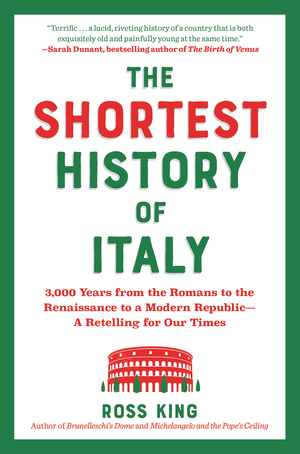
“Praise for The Shortest History of Italy
"Known for his impeccable research and engaging style, King is the perfect Virgil to guide us from The Aeneid to COVID-19 in this densely packed volume of tantalizing details. . . . King has a keen eye for the provocative anecdote, ranging from the debauchery of the emperors to papal history and the origins of the Mafia. . . . Each page brims with Bill Bryson–like trivia that is sure to delight.”—Booklist, starred review
“Terrific . . . a lucid, riveting history of a country that is both exquisitely old and painfully young at the same time.”—Sarah Dunant, bestselling author of In the Name of the Family
“A remarkably readable whirlwind tour of Italian history over the millennia, replete with conquerors, emperors, slaves, popes, assorted invaders, and filled with juicy historical nuggets. There’s nothing quite like it.”—David Kertzer, the Pulitzer Prize–winning author of The Pope and Mussolini and The Pope at War
“A rollicking introduction to the history of a country that, until barely 150 years ago, was not one. Vibrant, admirably clear, and often wryly amusing, Ross King’s narrative benefits again and again from his eye for the telling detail—a splendid achievement.”—John Hooper, author of The Italians and Italy correspondent for The Economist
“Jump into the Alfa Romeo and hold tight as Ross King speeds through Italian history with this effervescent and entertaining guide to the peninsula’s past.”—Catherine Fletcher, author of The Beauty and the Terror and The Black Prince of Florence
“History exerts a force [in Italy] that is multifaceted and ambiguous, especially to the outsider—but The Shortest History of Italy helps to render the country coherent.”—The Saturday Paper (Australia)
“Few have as much insight into the history of Italy as the author of Brunelleschi’s Dome, and here Ross King offers a masterful and perceptive account of Italian virtues—and sins—from the Romans to Berlusconi, as well as the country’s inimitable art and architecture. An ideal handbook for anyone who loves Italy and wants to dig a little deeper into the past of what Dante called il bel paese, or as Ross King puts it, Italy’s history of ‘resilience and rebirth.’”—Richard Owen, author of DH Lawrence in Italy, Hemingway in Italy, and Chaucer’s Italy
“Praise for Ross King
"King has made a career elucidating crucial episodes in the history of art and architecture.”—Time
“King has the gift of clear, unpretentious exposition, and an instinctive narrative flair.”—The Guardian
“[King’s] scrupulous excavation of social, political and religious texts, as well as art historical sources, permits him to tell a familiar story as though it had never been told before.”—Financial Times
“King is a deft storyteller.”—Telegraph